

Commercial Fountain Engineering Hydraulics and Filtration System

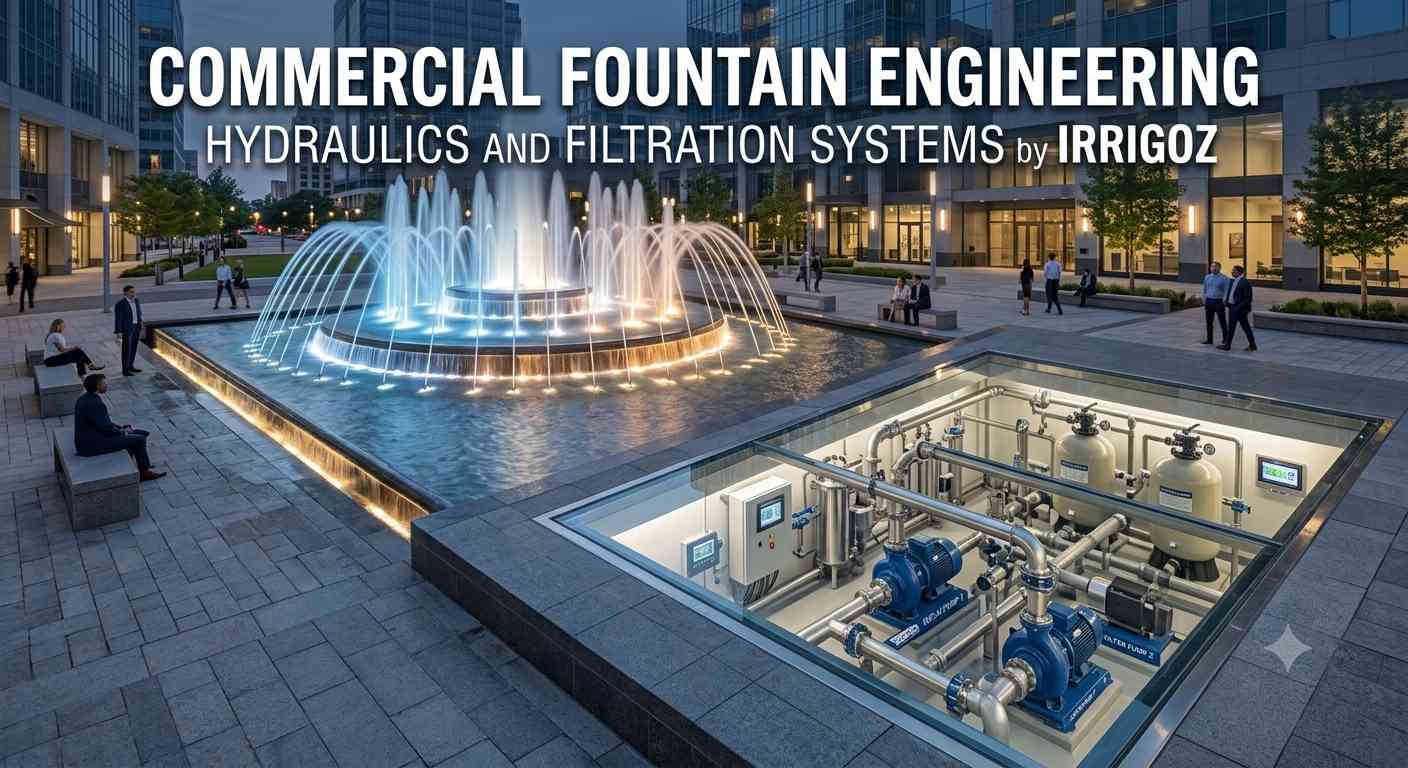
When observing a massive fountain projecting water dozens of feet into the air, it is easy to appreciate its aesthetic beauty. However, behind every breathtaking display lies a sophisticated network of industrial systems. For large-scale projects, commercial fountain engineering is the core foundation that ensures operational stability and public safety.
Without proper mechanical layout, massive water features can face rapid water degradation, pump failures, and structural damage. Consequently, managing hydraulics and filtration at scale requires absolute precision.
1. High-Load Hydraulic Balancing and Pipe Sizing
In small installations, water flow is relatively simple to manage. Furthermore, when dealing with thousands of gallons per minute (GPM), fluid dynamics become highly complex. Therefore, proper commercial fountain engineering must focus heavily on piping architecture.
Overcoming Friction Loss
As water travels through long loops of piping beneath a plaza, it experiences friction against the pipe walls. Engineers must use precise calculations to determine the exact pipe diameters. Usually, they utilize heavy-duty schedule 80 PVC or stainless steel lines. This ensures water pressure remains uniform across all vertical jets. If the pipe sizing is miscalculated, the nozzles furthest from the pump room will underperform, ruining the visual symmetry.
Suction and Discharge Dynamics
To prevent cavitation—a destructive phenomenon where vacuum bubbles form and implode inside a pump—engineers must meticulously design the suction lines. They must keep the flow velocity low on the suction side. Meanwhile, the discharge manifold must balance the pressure perfectly before distributing water to individual display nozzles.
2. Advanced Multi-Stage Commercial Filtration Systems
High-traffic public spaces subject water features to extreme environmental loads. These loads include wind-blown dust, organic debris, and direct human contact. Keeping massive volumes of water crystal clear requires an industrial-grade filtration loop entirely separate from the display loop.
[Fountain Basin] ---> (Debris Grates) ---> [High-Rate Sand/Glass Filters] ---> [UV/Chemical Treatment] ---> [Clean Return]
High-Rate Media Filtration
Commercial scale installations utilize large-scale sand or glass media filters. Glass media is highly preferred in modern engineering. This is because it filters particles down to 5 microns and resists bio-fouling. The turnover rate is typically scheduled for every 1 to 2 hours in high-traffic commercial zones.
Automated Surface Skimmers and Perimeter Drains
Heavy debris like leaves or wrappers usually float on the surface before sinking. Strategically placed surface skimmers and perimeter overflow stone channels catch these materials instantly. Consequently, they redirect them to strainers before they can reach and choke the main suction pumps.
3. Water Sanitation for Public Safety and System Longevity
Water clarity is only half the battle. In addition, chemical balancing is crucial to protect both public health and expensive mechanical components.
- Automated Inline Chemical Dosing: Manual chlorine dropping is impossible at a commercial scale. Industrial systems utilize automated controllers with probe sensors that continuously measure pH and Oxidation-Reduction Potential (ORP).
- Secondary UV Sterilization: To minimize heavy chemical odors in public plazas, high-output Ultraviolet (UV) sterilizers are integrated into the pipeline. As water passes through the UV chamber, bacteria are neutralized instantly at a cellular level.
4. The Engineering Necessity of Underground Surge Tanks
A common engineering failure in large fountains is ignoring water displacement. When massive vertical pumps turn on, hundreds of gallons of water are suddenly launched into the air. This causes the water level in the main basin to drop instantly.
To prevent pumps from drawing air and running dry, smart commercial fountain engineering configurations always incorporate an underground surge tank.
How It Works:
- When the fountain is turned off, excess water drains safely into the underground surge tank.
- When the display pumps activate, the surge tank feeds the system, keeping the main basin water level completely steady.
- It also acts as a containment buffer for wind-drift water loss, automatically triggering water make-up valves when total volume drops.
Conclusion: Built for Operational Excellence
In conclusion, commercial fountain engineering is a meticulous science where aesthetics meet industrial durability. By properly calculating hydraulic pressures, implementing high-rate multi-stage filtration, and incorporating automated sanitation loops, developers can ensure their landmarks remain functional, safe, and crystal clear for decades.
Need expert hydraulic engineering for your next commercial landmark? At Irrigoz Fountain Design and Installation, we engineer heavy-duty, high-performance water filtration and hydraulic systems tailored for massive public and corporate developments. Connect with our mechanical engineering experts today to blueprint your next project.